An AI answering service is software that picks up your business phone line, holds a natural conversation with the caller, and does something useful with the call — takes a message, answers a question, books an appointment, or passes the caller to a person — without a human needing to be available. It’s the AI-era version of the telephone answering service and the virtual receptionist, and it’s getting a lot of attention for a simple reason: most businesses miss far more calls than they think.
This guide covers what an AI answering service actually does, what the data says about the calls it exists to catch, roughly what it costs, and — the part most vendor pages skip — where “answering” the phone stops and converting the caller begins. Those are different jobs, and the difference decides whether the thing pays for itself.
What an AI answering service does
At the basic end, an AI answering service (you’ll also see it called an AI receptionist or AI virtual receptionist — the terms are used interchangeably) replaces voicemail. A caller rings, the AI answers in a natural voice, asks what they need, and captures it: name, number, reason for calling, best time to call back. That gets sent to you as a text or email, usually with a transcript. It runs 24/7, it never puts anyone on hold, and it answers every call at once rather than one at a time.
Mid-tier services add two things: answering common questions from a script you give them (opening hours, whether you cover a postcode, what a service roughly costs) and booking appointments straight into your calendar. The better ones can also transfer a live call to a named person when a rule is met — a new enquiry above a certain value, say, or an existing customer with a complaint.
What almost none of them do is sell. They’re built to receive a call well. That’s genuinely valuable — but it’s a floor, not a ceiling, and we’ll come back to it.
The calls it exists to catch: what the data actually says
Almost every article on this topic opens with the same number: 62% of calls to small businesses go unanswered. It’s worth knowing where that comes from. It traces back to a single study by 411 Locals, a local-SEO company, which monitored inbound calls to 85 businesses across 58 industries over 30 days and published the results in January 2016. Eighty-five businesses is a small sample, it’s a vendor’s own research, and it’s a decade old. But the breakdown it produced is more useful than the headline:
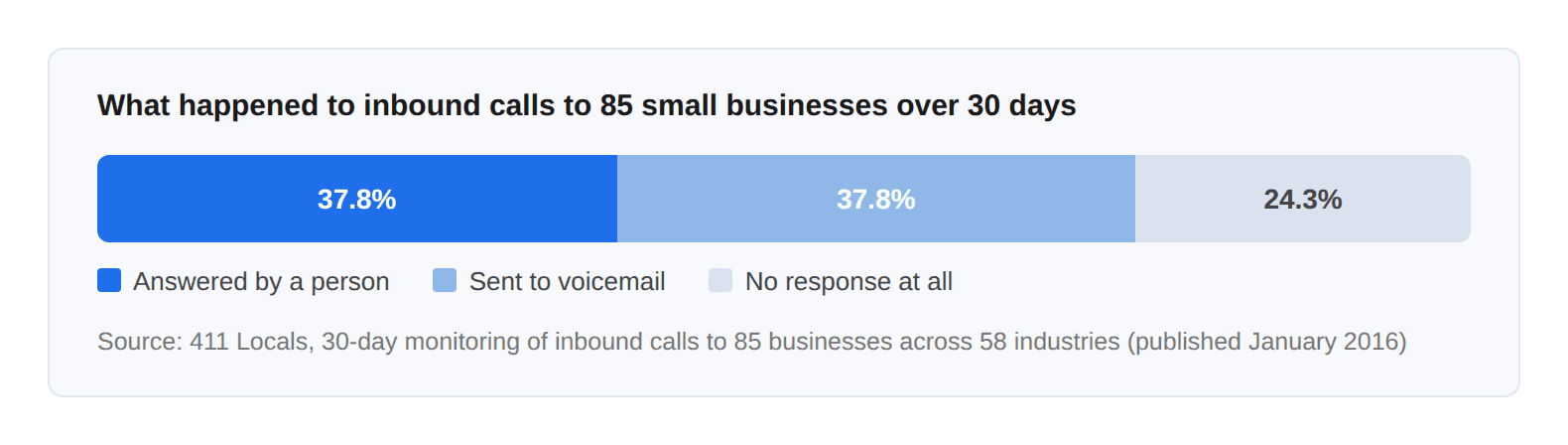
Only 37.8% of calls were answered by a person. Another 37.8% went to voicemail, and 24.3% rang out with no response at all. Seven in ten of the businesses answered fewer than half their calls. The “62%” is simply voicemail plus no-answer added together.
More recent, larger-scale numbers point the same way, if less dramatically. Invoca, a call-tracking platform, reports from its own data that 27% of calls to home-services businesses go unanswered — and that fewer than 3% of callers who are pushed to voicemail actually leave a message. Invoca doesn’t publish the sample behind those figures, so treat them as a large vendor’s platform data rather than an independent study. But the voicemail number is the one to sit with: if that’s even roughly right, then “it went to voicemail” and “we lost the call” are, for most callers, the same event.
And the calls aren’t casual. Google and Ipsos surveyed 3,000 US smartphone users in 2013 and found 70% had called a business directly from search results, and 47% said they’d “explore other brands” if they couldn’t quickly find a phone number. That research is old now, but it describes a behaviour that has only grown: the person calling is often mid-decision, comparing options, and one unanswered ring away from the next result down the page. That’s the same dynamic behind the speed-to-lead research — the window is short, and the caller doesn’t wait in it.
Will callers actually talk to an AI?
This is the reasonable objection, and the honest answer is: yes, with conditions — and the conditions are well documented. Salesforce commissioned YouGov to survey 15,015 consumers across 18 countries, including the UK, in mid-2024. Three findings matter here:
- Nearly 75% want to know they’re talking to an AI. Don’t disguise it. An agent that introduces itself honestly outperforms one pretending to be Sarah on reception, because the caller adjusts and gets on with it.
- 45% are more likely to use an AI agent if there’s a clear route to a human. The escape hatch is part of the product. An AI answering service with no transfer path is voicemail with better manners.
- 30% already prefer an AI agent when it means faster service — 37% among Gen Z and millennials. The preference isn’t for AI as such; it’s for not being kept waiting, and an AI that answers on the first ring beats a person who answers on the ninth.
Put together: callers will happily deal with an AI that’s upfront, quick, and can hand over when it needs to. What they won’t tolerate is a system that traps them — which is the one thing a badly set up AI answering service has in common with the IVR menus everyone already hates.
What an AI answering service costs
Off-the-shelf AI answering services are priced by usage, typically per minute of call time bundled into monthly tiers. As one public example, Rosie — a US service that appears near the top of the results for this term — lists $49 a month for 250 minutes on its entry tier (message-taking only), $149 for 1,000 minutes, and $299 for 2,000 minutes with appointment booking and call transfer included, as of September 2026. That’s one vendor’s list price, not a market average, but the shape is typical: cheap to start, with the useful features (booking, transfer) gated behind the middle tier.
For comparison, a human answering service or virtual receptionist is usually priced per call or per minute of agent time, and lands considerably higher for the same volume — which is the whole reason this category exists. The right question isn’t “what does it cost” but “what does it cost per call actually converted,” and that depends entirely on what the service does after it picks up.
Where answering stops and selling starts
Here’s the distinction the category tends to blur. Go back to the 411 Locals breakdown: 62% of calls weren’t answered by a person. An AI answering service fixes that number — every call gets picked up, every caller gets acknowledged, every message gets logged. Real progress.
But consider what happens next to a new enquiry. The AI takes the caller’s name and number and the note “wants a quote for a boiler replacement.” That message lands in your inbox at 7:40pm. Someone reads it the next morning and calls back at 10am. The caller — who, per the Google research, was probably comparing options when they rang — has by then spoken to whoever answered first. You’ve converted a missed call into a missed lead, with better paperwork.
The service that actually changes the outcome doesn’t just take the message; it has the conversation. It asks the questions your best rep would ask — which property, what’s the timeline, has anyone else quoted — handles the “roughly how much?” objection with a real answer rather than “someone will be in touch,” and books the survey visit into the calendar while the caller is still on the line. That’s the difference between an AI answering service and an AI voice agent built for sales: one is designed to receive a call, the other is designed to finish it. (We’ve broken down what that qualifying conversation actually involves, step by step.)
It’s the same principle as AI sales agents on chat and email — speed only matters if what arrives fast is a genuine conversation — and it’s why the 7:40pm call is really an out-of-hours coverage problem rather than a message-taking one. We’ve written separately about what happens to leads that arrive after hours; the short version is that a lead qualified and booked at 7:45pm is a different asset from a note read at 10am.
How to choose one
Whatever tier of the market you’re looking at, a short list of questions separates the useful products from the expensive voicemail:
- What can it do on the call, not after it? Message-taking, question-answering, booking, live transfer, qualifying — get the list in writing, and test it by calling the demo number yourself.
- Is it trained on your business or on a generic script? “Do you cover Chelmsford?” and “is the 3pm slot still free?” need your data, not a template.
- What’s the handover rule? When does it transfer to a person, to whom, and what happens if that person doesn’t pick up either? Per the Salesforce data, this is the feature callers care about most.
- Is it honest about being an AI? It should be. Three-quarters of callers want to know, and the ones who’d hang up on an AI will hang up faster when they realise they’ve been misled.
- How is it priced against outcomes? Per-minute pricing is fine for message-taking. For anything that’s supposed to produce booked appointments, ask whether the vendor will price against the appointments.
Where to start
Before you compare vendors, measure your own gap. Most phone systems can report answered versus missed calls; if yours can’t, ring your own business from a mobile at a few points across a week — including 6pm on a Thursday and midday on a Saturday — and note what happens. If the answer is voicemail more than a few times, you now have a number to work with, and the 411 Locals breakdown suggests you’re in large company.
Then decide which problem you’re solving. If it’s “we miss calls,” an AI answering service will fix it cheaply. If it’s “we miss calls and we lose the deals behind them,” you need the version that can hold the conversation. Renvoxa’s voice AI agents are built for the second problem, and the case studies show what that looks like on real call volumes.
If you’d rather hear it than read about it, you can arrange an AI demo and have the agent take your call.
FAQ
What is an AI answering service?
Software that answers your business phone with a natural-sounding AI voice, 24/7, and handles the call — taking a message, answering common questions, booking appointments, or transferring to a person — without a human needing to be available. It’s also sold as an “AI receptionist” or “AI virtual receptionist.”
What does an AI receptionist do?
The same thing as an AI answering service — the terms are interchangeable. Entry-level products take messages; mid-tier products answer scripted questions and book appointments; the more capable ones qualify callers and transfer live calls based on rules you set.
How much does an AI phone answering service cost?
Off-the-shelf services are usually priced by call minutes in monthly tiers — one public example starts at $49 a month for 250 minutes (message-taking only) and reaches $299 for 2,000 minutes with booking and transfer. Services that qualify and book sales calls are typically priced on outcomes rather than minutes.
Can I get an AI to answer my phone for a small business?
Yes — this is exactly the market most AI answering services are built for. You forward your existing number (or missed calls only) to the service, give it your business details and a set of instructions, and it starts answering. Setup is usually same-day.
Is an AI answering service the same as a voice AI agent?
Not quite. An AI answering service is designed to receive calls well — answer, log, route. A voice AI agent built for sales is designed to carry the conversation to a result: qualifying the caller, handling objections, and booking the next step while they’re on the line. The first fixes missed calls; the second fixes missed deals.