AI lead qualification is the use of an AI agent to have the first conversation with an inbound lead — asking the questions a sales rep would ask, scoring the answers against your criteria, and either booking the qualified ones into a calendar or routing the rest — in the minutes after the enquiry arrives rather than the days after. It’s the piece of the sales process most often described in vague terms (“AI handles your leads”) and least often explained step by step.
This guide does the step-by-step version. It answers the questions people actually ask about AI sales agents — what one does, whether it can replace a person, what it costs, where it falls over — and walks through a real first conversation from form submission to booked meeting, so you can judge the category on what it does rather than what it’s called.
What does an AI sales agent actually do?
An AI sales agent responds to a new lead within seconds, holds a two-way conversation by chat, email, SMS or voice, asks qualifying questions, answers the lead’s questions and objections using information about your business, and books a meeting or hands over to a person when the lead is ready. It doesn’t find leads; it works the ones you already have.
That last distinction matters because the term covers two very different products. Some “AI sales agents” are outbound prospecting tools that scrape lists and send cold sequences — the AI SDR category. The kind this article is about sits on the inbound side: it engages the leads that your marketing already produced and that, in most businesses, are waiting hours or days for a human reply. Everything below is about that second kind, which is what Renvoxa’s AI sales agents do.
Why the first conversation is the one that matters
Two things are true about inbound leads, and they pull in opposite directions. The first is that speed decides a lot: the 2011 Harvard Business Review study of 1.25 million leads found firms that made contact within an hour were roughly seven times more likely to qualify the lead than firms that waited even an hour longer. The second is that the people expected to make that contact don’t have the time. Salesforce’s latest State of Sales research — 4,050 sales professionals across 22 countries, surveyed in late 2025 — found sellers spend just 40% of their time actually selling. The previous edition, in 2022, put it at 28%.
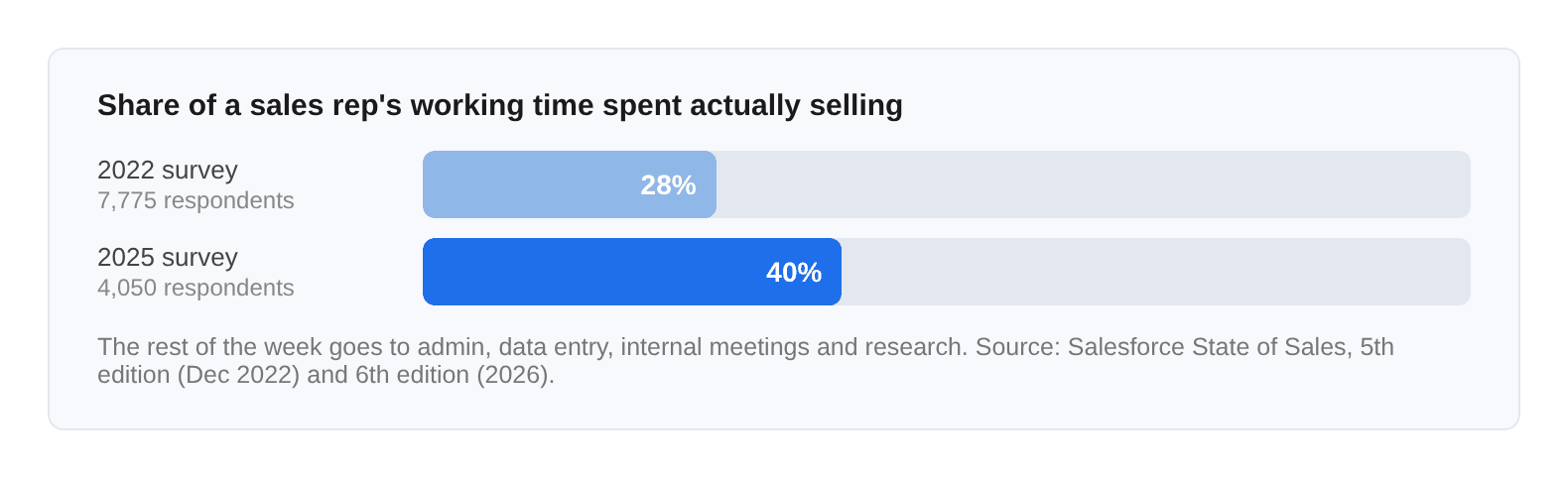
So the lead needs a reply in minutes, and the rep is available for roughly two days of each five. The gap between those two facts is where leads go quiet — and half of them are never contacted a second time. AI lead qualification exists to fill that specific gap: not to replace the rep’s selling time but to make sure that when the rep does pick up the phone, it’s to a lead who has already been qualified and has already agreed to the call.
What is automated lead qualification using AI?
Automated lead qualification using AI means an agent collects the qualifying information — budget, timeline, fit, authority, urgency — through a natural conversation rather than a form, scores the lead against rules you set, and acts on the result: booking a meeting, routing to a rep, nurturing, or closing the lead out as unqualified. The difference from older lead scoring is that the agent asks, rather than inferring from clicks.
Here’s what that looks like in practice, using a quote request to a home-improvement firm as the worked example. The same shape applies to a software demo request, a legal enquiry or a B2B services lead; only the questions change.
- Acknowledge in seconds, on the lead’s channel. The form says Sarah wants a quote for a kitchen extension. Within a minute, Sarah gets a message — SMS if she gave a mobile, email if not, or a call if the business runs voice agents — that references what she actually asked for. Not “thanks for your enquiry”, but “Hi Sarah, you asked about a kitchen extension at the Chelmsford property — is that a rear or side extension?”
- Ask the qualifying questions a rep would ask, one at a time. Rough size, whether planning permission is in place, timeline, whether other quotes are in progress, budget range if the business wants it asked. The agent adapts: if Sarah says “we haven’t thought about planning yet”, it explains briefly what that involves and carries on, rather than breaking.
- Answer the lead’s questions and objections. “Roughly how much per square metre?”, “how long does it take?”, “do you handle planning?” The agent answers from the business’s own information — ranges, typical durations, what’s included — and knows what it isn’t allowed to commit to.
- Score against your criteria. Inside your service area, realistic timeline, budget in range, decision-maker: qualified. Outside the area or a project the firm doesn’t do: closed out politely with a reason logged, so nobody calls her on Monday to find out.
- Book the next step while the lead is still engaged. “The next step is a 30-minute site visit — I’ve got Thursday at 10 or Friday at 2 with Dan. Which suits?” The appointment goes into Dan’s calendar, confirmation goes to Sarah, and the CRM record now holds the whole transcript.
- Hand over with context, and follow up if the lead goes quiet. Dan arrives on Thursday knowing the size, the planning status, the budget range and what Sarah was worried about. If Sarah had stopped replying at step 3, the agent would have followed up — the second, third and fourth attempts that human teams routinely skip.
Steps 1 and 6 are what speed-to-lead automation is built around; steps 2 to 5 are the qualification proper. All six run at 9pm on a Sunday exactly as they do at 10am on a Tuesday, which is the whole case for out-of-hours coverage.
Can an AI sales agent fully replace a human SDR?
For the first conversation with an inbound lead — response, qualification, objection handling and booking — yes, an AI sales agent can do the job an SDR would do, faster and at any hour. For the sales call itself, complex negotiation, and relationship-led deals, no: the realistic model is AI doing the qualifying and a person doing the closing.
It’s worth being precise about this because both the hype and the backlash get it wrong. The hype says the whole funnel is automated. The backlash says buyers will never talk to a machine. The evidence sits between: in Salesforce’s 2025 survey, 54% of sellers said they had already used AI agents, and 87% of sales organisations use AI in some form — the adoption is happening inside sales teams, not instead of them. What the agent takes off the SDR’s plate is the part that’s high-volume, time-sensitive and repetitive. What it leaves is the part that’s worth a salary.
The honest version of the question is therefore not “AI or SDR?” but “what should the SDR be doing at 9am on Monday?” If the answer is “working through 40 weekend form fills, most of which won’t pick up,” that’s the work to hand over. If the answer is “running three discovery calls that an agent booked and briefed,” that’s the SDR’s job done properly.
How much do AI sales agents cost?
AI sales agents are priced three ways: per conversation or usage credit (Salesforce’s Agentforce, for example, publishes $2 per conversation), per user per month (Agentforce’s unmetered tier is $125 per user), or per outcome — a fee per qualified appointment or per deal, where the vendor only earns when the agent produces a result. Which model is cheaper depends entirely on lead volume and conversion rate.
The arithmetic worth doing before comparing prices: take a month’s inbound leads, multiply by your current contact rate, and look at how many qualified conversations your team actually had. A per-conversation price looks cheap on low volume and expensive on high; a per-seat price is the reverse; an outcome price means you pay nothing for the leads that didn’t qualify, which for most businesses is most of them. Renvoxa prices on results for that reason — the risk sits with whether the conversations convert, not with whether the software was switched on.
What should you look for in an AI sales agent?
Look for five things: it responds on the lead’s own channel within a minute; it asks your qualifying questions rather than a generic script; it can answer objections from your business’s information; it books directly into your calendar and CRM; and it hands over to a person with the full context when a rule you set is met. Anything missing from that list means a human still has to finish the conversation.
Two tests cut through most vendor demos. First, submit your own enquiry form and see what happens at 8pm — not the demo, your actual flow. Second, ask the hardest objection your sales team hears every week and see whether the agent answers it or deflects to “someone will be in touch.” An agent that can’t handle your top objection isn’t qualifying; it’s taking messages, which is the AI answering service problem in a different wrapper.
What are the challenges of AI lead qualification?
The main challenges are over-qualification (an agent that asks too many questions before offering anything in return), under-qualification (one that books everybody), stale information (an agent that quotes last year’s lead times), and unclear handover (a qualified lead booked into a calendar nobody checks). All four are configuration problems, not AI problems — and all four show up in the transcripts within a week.
That last point is the practical answer to “how do I know if it’s working?” Every conversation is logged. Read twenty of them in the first fortnight and you’ll see exactly where the agent is losing people — usually a question asked too early, or an objection it hasn’t been given the answer to — and fix it in an afternoon. A human SDR’s conversations are mostly invisible; an agent’s are all there.
Where to start
Pull three numbers before you talk to any vendor: how many inbound leads you got last month, how many were contacted within an hour, and how many got more than one follow-up attempt. The gap between the first number and the other two is the work an AI sales agent would do. If the gap is small, you don’t need one. For most businesses it isn’t small, and the case studies show what closing it looks like.
If you’d rather see the six steps above run on one of your own leads than read about them, you can arrange an AI demo and watch a qualification conversation happen live.
FAQ
What is an AI appointment setter?
An AI appointment setter is an AI sales agent whose end goal is a booked meeting: it engages the lead, qualifies them, and offers calendar slots directly, writing the confirmed appointment into the rep’s calendar and CRM. The term is often used interchangeably with AI sales agent on the inbound side.
What’s the difference between an AI sales agent and an AI SDR?
In common usage, “AI SDR” usually means outbound — prospecting, list-building and cold outreach. “AI sales agent” more often means inbound — responding to, qualifying and booking leads that already enquired. Some vendors use the terms loosely, so check which side of the funnel a product actually works on.
Does AI lead qualification work for B2B?
Yes — the qualifying questions change (company size, use case, decision process, timeline) but the mechanics are identical. B2B leads are typically higher value and lower volume, which makes the cost of a slow first response higher, not lower.
Will leads know they’re talking to an AI?
They should — a well-configured agent says so. Most people are comfortable with that when the reply is fast, relevant and there’s a clear way to reach a person; what they object to is being misled or trapped.
How quickly can an AI sales agent be set up?
The agent itself can be live in days. The time goes into giving it the right material: your qualifying criteria, the answers to your common objections, the calendar and CRM connections, and the handover rules. Businesses that already have a sales playbook written down set up fastest.