A standard 9-to-5, Monday-to-Friday business is open for 40 hours out of the 168 hours in a week — which means the phone, the inbox, and the contact form are unattended for the other 76%. Every after-hours lead that lands in that window sits untouched until someone gets back to a desk, and by then the moment that made a prospect pick up the phone or fill in a form has usually passed.
This isn’t a new problem — businesses have closed overnight and on weekends for as long as businesses have existed. What’s changed is that the leads themselves don’t stop arriving just because the office does, and the research on response time makes it clear how much that gap actually costs. Here’s what happens to a lead in the hours after it arrives, what the data says about closing that window, and where AI genuinely changes the equation rather than just papering over it.
The gap is bigger than most businesses assume
Take a typical service business: open 9am to 5pm, Monday to Friday. That’s 40 hours a week with someone available to answer a call or reply to a form. The other 128 hours — evenings, nights, and the entire weekend — the business is effectively dark to anyone who wants to get in touch.
None of that is a criticism of the business. Nobody expects a plumber, a law firm, or a B2B software vendor to staff a switchboard at 2am. But the prospect submitting a quote request at 9pm on a Tuesday, or browsing pricing pages on a Saturday afternoon, doesn’t necessarily know or care that they’ve landed outside business hours — they were ready to act when they acted, and the research on response time is unambiguous about what happens when that readiness isn’t met with a reply.
This isn’t only a consumer pattern, either. B2B buying decisions are rarely made inside a 9-to-5 window — the person comparing quotes or reading case studies at 8pm is often doing it in the gap between their day job and the rest of their evening, because that’s when they actually have time to think about the decision rather than react to it in a meeting. The enquiry lands out of hours precisely because the buyer’s own working day was already full of everything except this decision.
What the research says about the delay itself
The most rigorous public study on this is the 2011 Harvard Business Review research by James Oldroyd, Kevin McElheran, and David Elkington — a separate, later piece of work from the more commonly cited 2007 study on the “5-minute rule.” This one looked specifically at how the odds of qualifying a lead change with delay, across two datasets: an audit of 2,241 U.S. companies timing their response to a test lead, and a separate analysis of 1.25 million real sales leads across 29 B2C and 13 B2B companies.
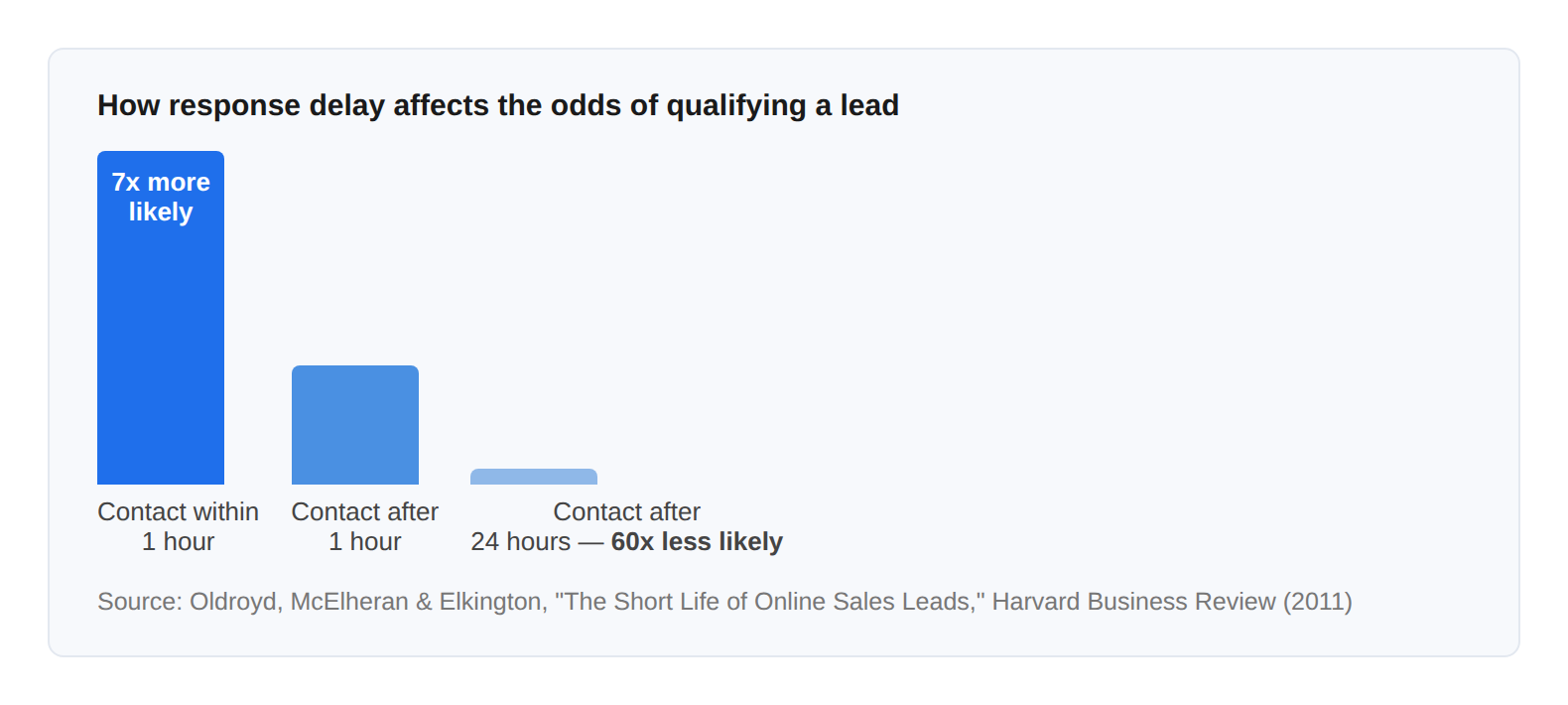
Firms that made contact within an hour of a lead coming in were nearly seven times more likely to qualify it than firms that waited even a single hour longer — and more than 60 times more likely than firms that took 24 hours or more. That 24-hour comparison is the one that matters for out-of-hours enquiries specifically: a lead that arrives at 7pm on a Friday and doesn’t get a reply until Monday morning hasn’t waited “a weekend” from the business’s point of view — it’s waited well past the point where the same research shows most of the opportunity has already evaporated.
The same study found that even during business hours, most companies aren’t close to fast: only 37% of the companies audited responded to a test lead within an hour, 16% took between one and 24 hours, 24% took longer than a day, and 23% never responded to the lead at all. If more than a third of businesses can’t manage a one-hour response when they’re open, the odds of a fast reply to something that arrives at midnight are close to zero without something automated running the desk.
Why this keeps happening
- Staffing round the clock doesn’t scale. Paying someone to sit by the phone or inbox overnight and through the weekend, for the volume of leads most businesses get outside hours, rarely pencils out — which is exactly why most businesses don’t do it, and why the gap persists even at well-run companies.
- Voicemail and generic auto-replies don’t count as a response. A message that says “we’ll get back to you Monday” confirms to the prospect that they’ve been heard, but it doesn’t do any of the things a real first contact does — no qualifying, no objection handling, nothing that moves the conversation forward. It buys goodwill, not a deal.
- The prospect isn’t waiting for you specifically. If a competitor’s site or AI agent answers the same enquiry at 9pm, that’s often who gets the meeting by the time the original business opens on Monday. Out-of-hours enquiries are frequently people actively comparing more than one option right now, not people who’ve committed to whoever replies first come morning.
- The searching behaviour behind it has shifted. Google has reported that searches for “open now near me” grew by more than 400% year-on-year between 2020 and 2021 — a rough proxy for a broader habit: people increasingly expect to find and act on information whenever they happen to be looking, not only during a business’s opening hours.
What “closing the gap” actually requires
The instinct is often to reach for an answering service or an out-of-hours call centre, and for pure call-handling that can work. But there’s a difference between someone answering the phone and someone doing anything useful with the conversation. A basic AI answering service or virtual receptionist that just takes a message is only marginally better than voicemail — it confirms the enquiry was received, but the qualifying, the objection-handling, and the booking still wait until Monday. (We’ve written separately about what an AI answering service actually does — and where it stops.)
What actually closes the gap is a system that can carry the whole conversation the moment it starts, at any hour: engaging the lead, asking the questions a rep would ask, handling the “how much does this cost” or “does this work for my situation” objections in a genuinely conversational way, and getting a qualified prospect booked directly into a calendar before they’ve had the chance to look elsewhere. That’s the specific job out-of-hours AI is built to do — not a message-taking service, but the same first conversation your best rep would have, running at 2am on a Saturday exactly as it would at 2pm on a Tuesday.
It’s the same principle behind AI sales agents generally: speed matters, but only if what arrives quickly is a real conversation rather than an acknowledgment. A fast, empty reply doesn’t move a prospect any closer to booking — it just proves someone was technically listening.
In practice that means the agent needs to do three things a message-taker can’t: ask the specific qualifying questions your team would ask (budget, timeline, the details that decide whether this is a real opportunity), respond to the objections that come up in almost every first conversation (“how does this compare to X,” “what does it cost,” “we tried something like this before”) without falling back on a script, and end the conversation with something booked rather than just noted. A lead that’s qualified and booked by 9:15pm on a Tuesday is a fundamentally different asset on Wednesday morning than one that’s sitting as an unread form submission.
Where to start
Before changing anything, it’s worth finding out what’s actually happening in your own funnel: submit your own contact form at 9pm on a Friday, or call your own number on a Sunday afternoon, and see what a real prospect experiences. If the answer is voicemail, a “we’re closed” auto-reply, or nothing at all, that’s the gap — and per the research above, every hour it stays open is working against you.
From there, the question is which part of the problem is costing you the most: leads arriving with nobody available to answer, as covered here, or the leads already sitting in your CRM that nobody’s followed up with — both are covered by Renvoxa’s speed-to-lead automation, and the case studies show what closing either gap looks like in practice for businesses with a genuine follow-up problem.
If you’d rather see it running on your own lead flow than read about it, you can arrange an AI demo and watch a real out-of-hours conversation play out.
FAQ
What percentage of leads arrive outside business hours?
There’s no single, methodologically transparent public study that answers this precisely — figures vary by industry and several widely quoted numbers online aren’t traceably sourced. What’s verifiable is the arithmetic: a standard 9-to-5, five-day operation is open 40 hours out of a 168-hour week, so any enquiry outside that window, by definition, arrives when nobody’s watching.
Does an auto-reply or voicemail count as responding to a lead?
Not in the way that matters for conversion. It confirms the enquiry was received, but the research on response time is about genuine first contact — qualifying, answering questions, moving the conversation forward — none of which a generic acknowledgment does.
Is an AI answering service the same as an AI sales agent?
Not quite. A basic AI answering service or virtual receptionist typically takes a message or answers simple questions. An AI sales agent carries the full first conversation — qualifying the lead, handling objections, and booking a meeting — which is the difference between an enquiry being logged and an enquiry turning into a booked call.
How much does response delay actually affect the odds of closing a lead?
Harvard Business Review research found companies contacting a lead within an hour were roughly seven times more likely to qualify it than those waiting even one hour longer, and more than 60 times more likely than those waiting 24 hours or more.
Does the after-hours gap matter for B2B, or just consumer businesses?
Both. B2B buyers frequently research and enquire outside their own working day — evenings and weekends are often when they actually have time to compare options rather than react to them between meetings. A slower B2B sales cycle doesn’t make the first-response window less important; it just means the cost of a missed window shows up later, as a deal that quietly goes to whichever vendor replied first.