Lead reactivation is the process of re-opening conversations with leads that already exist in your CRM — people who enquired, downloaded something, requested a quote, or spoke to someone once, and then went quiet. It’s the opposite of lead generation: rather than paying to bring new prospects in at the top of the funnel, it works the ones that already came in and were never properly followed through.
Most businesses treat those contacts as dead. The data says most of them aren’t — they’re abandoned, which is a different thing. Here’s what the numbers actually show about the leads sitting in your database, why they’re usually worth more than the next batch of new traffic, and what a reactivation campaign has to do to convert them.
Every lead in your CRM already cost you something
Start with what a new lead actually costs. WordStream’s 2026 Google Ads benchmarks — drawn from 13,474 US search campaigns running between April 2025 and March 2026 — put the median cost per lead at $66.69 across 23 industries. That figure is the middle of the range, not the top: legal services averaged $131.63 per lead, real estate $102.51, furniture $106.70. And that’s paid search alone — it excludes the salary of whoever handled the enquiry, the tooling, and everything else that went into getting the lead to the point of raising a hand.
Now apply that to your own database. If there are a thousand contacts in your CRM who enquired and never converted, that’s — at the median — roughly $66,690 of acquisition spend already sunk into people who expressed interest and then heard nothing back, or nothing useful. (That’s illustrative arithmetic, not a study, but the point holds at any cost per lead: you’ve already paid for these people once.)
That’s the whole case for database reactivation in one sentence: the most expensive part of the process — getting a stranger to identify themselves as interested — is already done. What’s left is the conversation nobody finished.
Most “dead” leads were never actually worked
The instinct is to assume the leads in the CRM went cold because they weren’t interested. The best data on this suggests something less flattering: they went cold because nobody followed up more than once.
Velocify’s Ultimate Contact Strategy study — nearly 3.5 million leads generated in the first half of 2012, tracked through the end of that year — found that 50% of leads are never called a second time. The same dataset found that 93% of all leads that eventually converted were reached by the sixth call attempt, and that conversion odds don’t meaningfully improve after around seven touches.
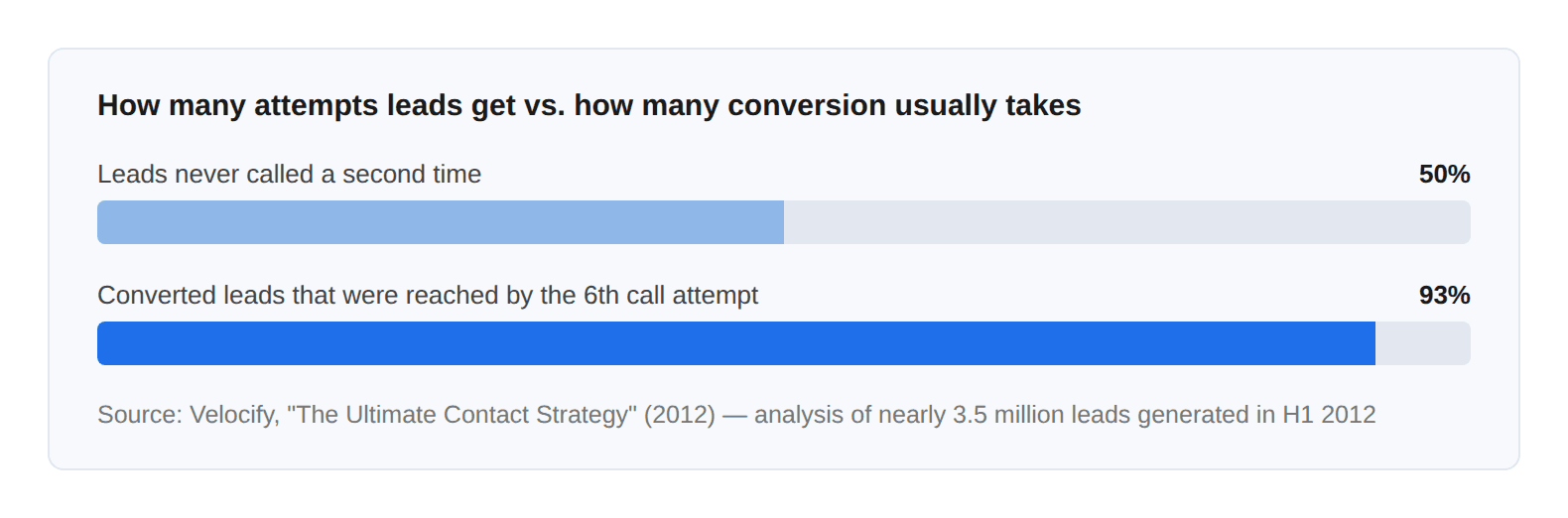
Put those two numbers next to each other. Conversion usually takes several attempts — but half of all leads get exactly one. A large share of the “dead” contacts in a typical CRM aren’t people who said no. They’re people who were called once, didn’t pick up, and were quietly moved on from. The study is over a decade old and was published by a dialler vendor, which is worth knowing — but the sample is enormous, and nothing in how sales teams are staffed since then suggests the one-attempt problem has gone away.
This is the same failure covered in the speed-to-lead research, just further down the line. Slow first response creates the dead lead; a single follow-up attempt seals it. Reactivation is what happens when you go back for the second conversation the lead never got.
The database is losing value while it sits there
There’s a reason not to leave this for next quarter. Contact data degrades on its own: people change jobs, switch email addresses, abandon old accounts. HubSpot cites MarketingSherpa research putting B2B database decay at around 2.1% per month — roughly 22.5% a year. That research is older, and the exact rate will vary by market, but the direction isn’t in dispute: a lead that’s reachable today may simply not be reachable in eighteen months, regardless of how interested they were.
So the dormant portion of a CRM isn’t a stable asset waiting to be tapped whenever it’s convenient. It’s a depreciating one. Every quarter it sits untouched, a slice of it becomes permanently unrecoverable — not because the people stopped being prospects, but because the contact details stopped working.
About the “5 to 25 times cheaper” statistic
You’ll see it quoted in almost every piece on this topic: acquiring a new customer costs five to twenty-five times more than retaining an existing one. It’s usually attributed to Harvard Business Review, and HBR did publish it, in a 2014 piece — but that article states the figure without citing where it came from, and we couldn’t trace an original study behind it. It may well be directionally right. We just don’t lean on it here, because the arithmetic above doesn’t need it: a lead you’ve already paid $67 to acquire costs a fraction of that to message again, and that’s true whether the “real” multiple is 5x, 25x, or something else entirely.
What a database reactivation campaign actually involves
The word “campaign” makes this sound like a mass email — pick a list, write a “just checking in” message, hit send. That approach mostly measures how many people have changed email addresses. A reactivation effort that actually converts looks more like the first sales conversation the lead should have had, run at scale:
- Segment before you send anything. Someone who requested a quote eight months ago and someone who downloaded a guide two years ago are different conversations. Exclude current customers, active opportunities, and anyone who’s asked not to be contacted — a reactivation campaign that pesters live deals does more damage than it recovers.
- Open with something specific, not a check-in. The message that works references what the lead actually asked about, and gives them an easy way to say “still interested,” “not now,” or “solved it elsewhere.” All three are useful answers. Silence is the only bad outcome.
- Be ready to hold the conversation when they reply. This is where most reactivation efforts fall over. The message goes out, a proportion of people respond — at 9pm, on a Saturday, three days later — and the reply sits in an inbox until someone gets to it, at which point the lead is cold for the second time. The channel that sends the message has to be the same one that can qualify the reply, handle “how much is it now,” and book the call.
- Route what’s qualified, log what isn’t. A good reactivation pass doesn’t just produce meetings; it cleans the database. “Not interested, ever” is a useful result — it stops that contact being re-messaged and lets the sales team’s attention go where there’s actual intent.
That last point is why this is a job increasingly handed to AI sales agents rather than to a rep with a spreadsheet. The volume is large, the timing of replies is unpredictable, and the conversations are individually short but collectively enormous — exactly the profile a human team can’t staff economically and an agent can run around the clock. Renvoxa’s database reactivation service runs this on a pay-for-results basis for that reason: the leads are already there, so the risk sits on whether the conversations convert, not on whether the outreach happens.
The same principle applies further down the funnel, too. An abandoned checkout is a reactivation problem with a much shorter clock — someone got as far as intent and stopped — which is why abandoned cart recovery works on the same logic: go back, hold the conversation, remove the reason they stopped.
Where to start
Pull a simple report before deciding anything: every contact in the CRM with no activity in the last 90 days who isn’t a customer and hasn’t opted out. Count them. Multiply by whatever your real cost per lead is — or by $67 if you don’t know it. That number is what’s sitting idle.
Then look at how many of those contacts show more than one logged follow-up attempt. If the answer is “most of them got one,” the Velocify data says you’re not looking at a list of rejections — you’re looking at a list of conversations that never happened. The case studies show what working that list properly looks like in practice.
If you’d rather see it run against a slice of your own database than read about it, you can arrange an AI demo and watch a real reactivation conversation play out.
FAQ
What is lead reactivation?
Lead reactivation is re-opening contact with leads already in your CRM who enquired but never converted — through personalised outreach that qualifies whether they’re still interested and, if so, books the next step. It’s distinct from lead generation, which brings new prospects in.
Is lead reactivation the same as database reactivation?
Effectively, yes. “Database reactivation” usually describes the campaign — working a whole segment of dormant contacts at once — while “lead reactivation” describes what happens to each individual lead within it. Both refer to converting existing, unconverted contacts rather than acquiring new ones.
How old is too old for a lead to reactivate?
There’s no fixed cut-off, but two things shift the odds: how specific the original enquiry was (a quote request ages better than a whitepaper download) and how much the contact data has decayed since. Given the roughly 2% per month decay rate in B2B data, leads under 12–18 months old are usually the most productive segment to start with.
Won’t messaging old leads annoy them?
A generic “just checking in” blast can. A message that references what they actually asked about and makes it easy to say “no thanks” generally doesn’t — and a clear “not interested” is a useful outcome, because it cleans the database and stops that contact being messaged again.
What response rate should a reactivation campaign get?
It varies widely by industry, lead age, channel, and how specific the outreach is, and anyone quoting a single universal percentage is guessing. The honest approach is to run a segment, measure replies, qualified conversations, and booked meetings separately, and let that set the benchmark for the rest of the database.